
Even if your sport of choice isn’t baseball, your expectation is that your team drafts athletic players, and your favorite franchise will ” coach ’em up”. Player development is crucial to the players progress from the amateur side to the professional side of the sport. Professional baseball has a long, grueling season. In college or high school baseball your team starts their best pitcher once a week, the Friday night starter is the man! An important part of development for starting pitchers is the introduction to the pro baseball timeline. The pitcher moved from once every seven days to once every five days. There is much less recovery time (33%), so areas like volume of throws, timing of long toss and bullpen days change. The schedule of weight training, arm care and conditioning also change. Relief pitchers must also adapt to routines that allow them to be available to pitch more frequently than they were accustomed to in college or high school baseball. Some pitchers change roles once into the professional ranks. This is where the growth mid set and long-term vision comes into play.
When a pitcher arrives in a development program the work begins immediately. Scouts have provided information about medical history, prior pitcher workload and any other pertinent information that would be beneficial is assisting the player in his or her new endeavors. The medical team performs an exam on each player, and we discover any limitations on that player. Physical therapists can also help determine joint integrity for the players and prescribe any corrective exercises to enhance player performance and health. A movement assessment is also done for each player. Here we can discover why a player/ pitcher moves the way they do. We can also find areas where a player can improve how he moves, workouts begin to be very individualized as different players have different needs. The strength and conditioning staff are also involved. We may discover strength deficits or areas of focus for the player. Everyone works together to put together a development plan for the athlete. A strength coach and nutritionist will work together, communicate with the player specific goals. A player may have a goal of weight gain or a goal to change his body composition through the training and a dietary plan. Why guess when you can assess? I have certifications in Functional Movement Systems simply to better understand the importance and general concepts of human movement. I also am certified in OnBaseU, it a fantastic group that is geared towards pitcher specific or hitter specific movement patterns. This group is huge on the PGA tour as well. Today’s athletes across the globe are setting world records in every type of event, I attribute these feats to more intelligent training, elite motion capture usage and the implantation of a well devised improvement plan. How athletes move is very important to how we teach them. Movement specialists can determine if the athlete is an Aerial mover or a Terrestrial mover. All of this information is useful in getting the most out of the athlete. There is no cookie cutter way for the pitcher to move on the mound, the good organization will develop pitchers with efficient deliveries. Good deliveries produce two or more pitches thrown on a downhill plane and increase the likelihood of staying healthy.
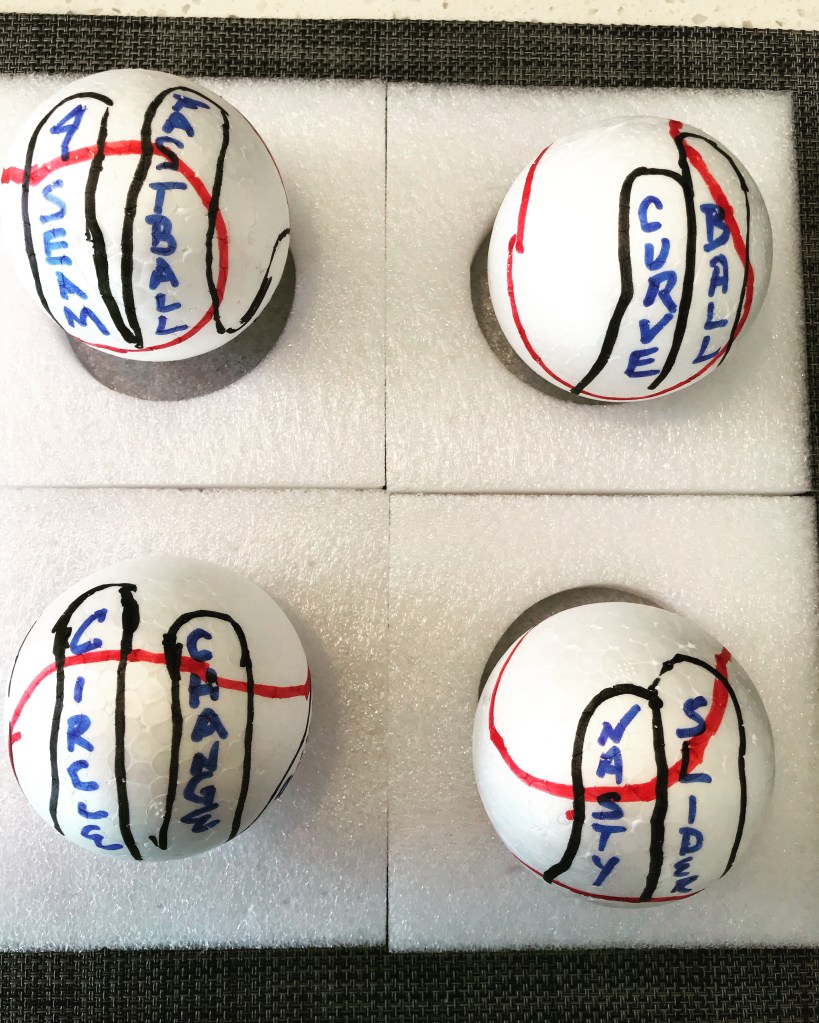
The athlete has a development plan for his arm care, strength goals, movement pattern training, body composition goals, he has been educated on recovery and sleep. Now, we need to develop his pitching plan and pitches. Pitching can be argued for days on end, but the fact is- the pitcher must get ahead in the count and make the batter swing at his pitch, period- paragraph. Getting ahead in the count becomes more refined at the most elite level and discovering one’s put away pitch will take some time (minor league innings). The athlete will also need a coach who is invested in the development process and a staff around the player who does not care who is given credit for improvement, just that the player progresses. A pitcher arrives on the scene with an arsenal of pitches. We want to make those pitches better, improve his command, improve how he or she will sequence those given pitches. Pitch tracking data is amazing. Without going into anything complicated I can tell you that pitch characteristics are measure by missile tracking technology, by Doppler Radar, sophisticated stuff, you get the idea. Analysts help the coach and the pitcher in discovering areas of growth and improvement in his repertoire of pitches. Today’s development team is all encompassing. Successful pitchers always are seeking a competitive edge. Designing pitches is one of them. Remember when we said we want to create an environment where failure is not fatal. Tom Browning, Mr. Perfect, was a friend, mentor, coach. Tom also authored a Perfect Game, the 12th in ML history, on September 16, 1988. His changeup was a pitch he developed after his first season. He told me that the first one he threw in a game ended up on the street for a long homerun. He was encouraged by his pitching coach to throw it again and again. This education and thought process led him to having a devasting out pitch in the Major Leagues. No data was needed in this instance. The goal is to teach each player the skills needed to be a successful major leaguer. Growth does not end when a player reaches the highest level. Teaching and player aptitude go hand in hand. Nick Saban once stated,” good players want to be coached, great players want to be told the truth”. Relationships drive talent growth. This is a missing piece in some organizations. On my end, I always wanted the athlete to be the most educated most prepared player on the field.
#coaching #baseball #development #growthmindet #process
 No BS Baseball